
Communicate personnel changes internally: Templates & best practices
Staff changes require clear and sensitive internal communication. This article shows proven best practices, typical mistakes, and a practical template that companies use to create transparency and trust.
1. The typical problem
Personnel changes are part of everyday business life: new colleagues start, roles change, managers change or employees leave the company.
Especially when it comes to such topics, Internal communication is particularly sensitive — and at the same time often unclearly regulated.
In practice, this often results in:
- Rumors instead of clarity
- Uncertainty in the team
- conflicting information
Not because companies mean badly — but because Timing, content, and channel are not properly coordinated.
2. Why personnel changes are often miscommunicated
Typical mistakes in internal communication due to personnel changes:
- Information is shared too late
- Employees receive news “via detours”
- Content is too vague or too detailed
- Managers communicate inconsistently
- Not all employees are reached
It becomes particularly problematic when information only once be sent by email and then disappear.
3. The decisive question
The central question is not:
“Which template do we use for personnel changes? ”
But:
“How do we create transparency without increasing uncertainty? ”
In the event of personnel changes, good internal communication ensures Orientation and trust — poor communication creates speculation.
4. Best practices for internal communication during personnel changes
1. Choose a time consciously
Staff changes should be made internally before external Be communicated — and as closed as possible, not in bits and pieces.
2. Clear but not excessive
Employees expect:
- What is changing
- From when
- Who it concerns
No justifications, no internal details.
3. Unified message
HR, executives and management must The same core message communicate — regardless of the channel.
4. Ensuring visibility
Especially when it comes to sensitive topics, a single channel is rarely enough. Repetition increases understanding and reduces rumors.
Example 5: Internal notification in case of personnel change (simplified)
subject: Personnel change in sales
Max Mustermann will take over as head of the sales team on April 1.
He succeeds Anna Beispiel, who is leaving the company at her own request.
For the team, there will initially be no change in the operational process.
If you have any questions, the respective manager is available as a contact person.
Objective, transparent — but easy to missif it is only sent once via email.
6. Typical objections — arranged realistically
- “The issue is too sensitive for broad communication. ”
- → It is precisely then that clear, controlled information is needed.
- “We don't want to create unrest. ”
- → Ambiguity creates more unrest than transparent communication.
- “Not everyone needs to know everything. ”
- → Right — but everyone should know the same official status.
7. Why the communication channel is crucial
Personnel changes have a stronger effect when they:
- visibly
- consistent
- repeatedly
- be communicated.
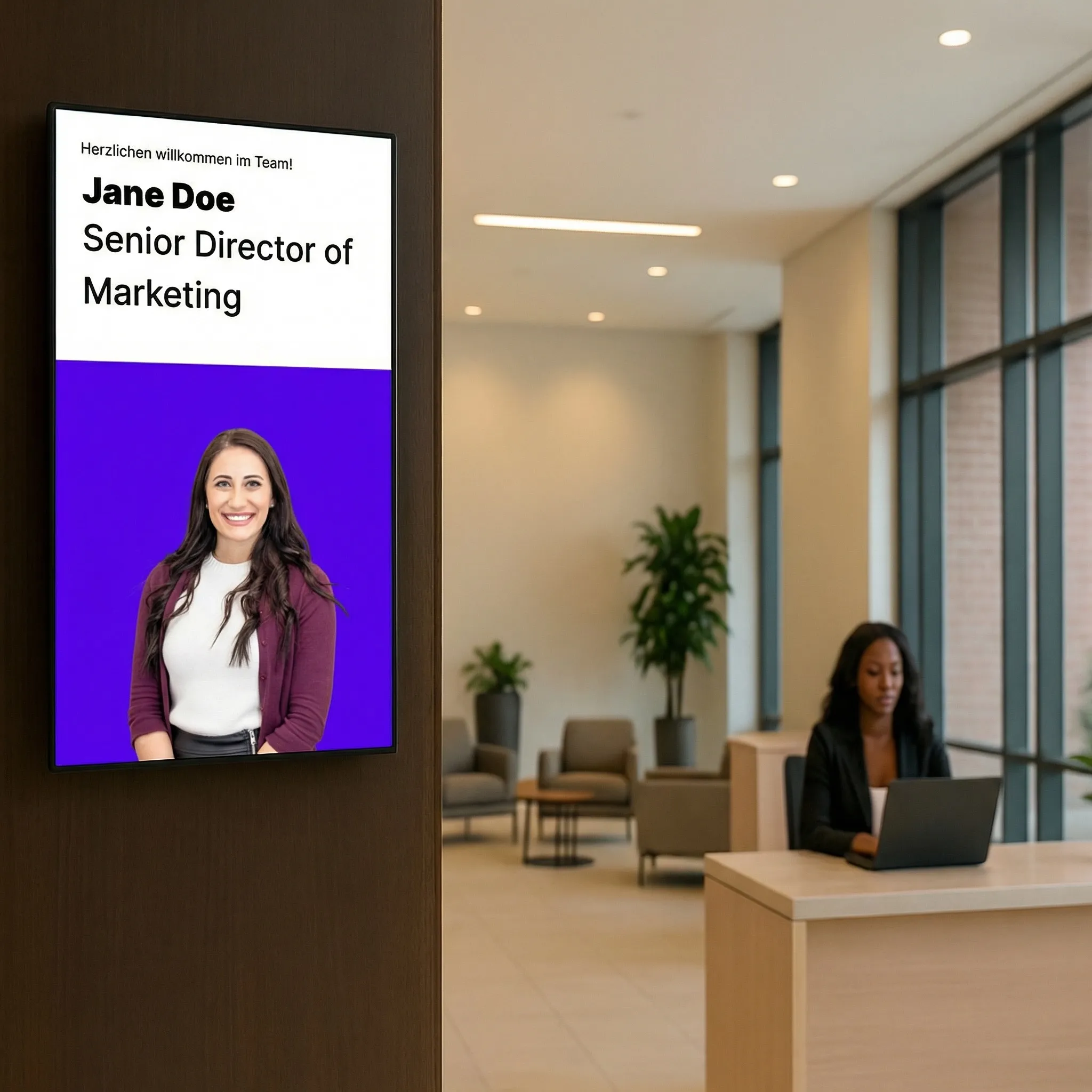
Visual channels such as info screens at central locations help provide information:
- Perceived several times
- Can also reach employees without a PC workstation
- replace rumours with official messages
This provides additional security, especially during transition phases.
8. Conclusion
Communicating personnel changes internally means more than using a clean template.
Decisive are Timing, Clarity, and Visibility. Companies that communicate changes transparently and consistently strengthen trust — even in difficult situations.
Emphasize your product's unique features or benefits to differentiate it from competitors
In nec dictum adipiscing pharetra enim etiam scelerisque dolor purus ipsum egestas cursus vulputate arcu egestas ut eu sed mollis consectetur mattis pharetra curabitur et maecenas in mattis fames consectetur ipsum quis risus mauris aliquam ornare nisl purus at ipsum nulla accumsan consectetur vestibulum suspendisse aliquam condimentum scelerisque lacinia pellentesque vestibulum condimentum turpis ligula pharetra dictum sapien facilisis sapien at sagittis et cursus congue.
- Pharetra curabitur et maecenas in mattis fames consectetur ipsum quis risus.
- Justo urna nisi auctor consequat consectetur dolor lectus blandit.
- Eget egestas volutpat lacinia vestibulum vitae mattis hendrerit.
- Ornare elit odio tellus orci bibendum dictum id sem congue enim amet diam.
Incorporate statistics or specific numbers to highlight the effectiveness or popularity of your offering
Convallis pellentesque ullamcorper sapien sed tristique fermentum proin amet quam tincidunt feugiat vitae neque quisque odio ut pellentesque ac mauris eget lectus. Pretium arcu turpis lacus sapien sit at eu sapien duis magna nunc nibh nam non ut nibh ultrices ultrices elementum egestas enim nisl sed cursus pellentesque sit dignissim enim euismod sit et convallis sed pelis viverra quam at nisl sit pharetra enim nisl nec vestibulum posuere in volutpat sed blandit neque risus.
Use time-sensitive language to encourage immediate action, such as "Limited Time Offer
Feugiat vitae neque quisque odio ut pellentesque ac mauris eget lectus. Pretium arcu turpis lacus sapien sit at eu sapien duis magna nunc nibh nam non ut nibh ultrices ultrices elementum egestas enim nisl sed cursus pellentesque sit dignissim enim euismod sit et convallis sed pelis viverra quam at nisl sit pharetra enim nisl nec vestibulum posuere in volutpat sed blandit neque risus.
- Pharetra curabitur et maecenas in mattis fames consectetur ipsum quis risus.
- Justo urna nisi auctor consequat consectetur dolor lectus blandit.
- Eget egestas volutpat lacinia vestibulum vitae mattis hendrerit.
- Ornare elit odio tellus orci bibendum dictum id sem congue enim amet diam.
Address customer pain points directly by showing how your product solves their problems
Feugiat vitae neque quisque odio ut pellentesque ac mauris eget lectus. Pretium arcu turpis lacus sapien sit at eu sapien duis magna nunc nibh nam non ut nibh ultrices ultrices elementum egestas enim nisl sed cursus pellentesque sit dignissim enim euismod sit et convallis sed pelis viverra quam at nisl sit pharetra enim nisl nec vestibulum posuere in volutpat sed blandit neque risus.
Vel etiam vel amet aenean eget in habitasse nunc duis tellus sem turpis risus aliquam ac volutpat tellus eu faucibus ullamcorper.
Tailor titles to your ideal customer segment using phrases like "Designed for Busy Professionals
Sed pretium id nibh id sit felis vitae volutpat volutpat adipiscing at sodales neque lectus mi phasellus commodo at elit suspendisse ornare faucibus lectus purus viverra in nec aliquet commodo et sed sed nisi tempor mi pellentesque arcu viverra pretium duis enim vulputate dignissim etiam ultrices vitae neque urna proin nibh diam turpis augue lacus.