
Internal message to all employees: structure, examples and common mistakes
How do you create an internal message that is actually received? This article shows the right structure, practical examples and typical mistakes — and explains why the chosen communication channel is decisive.
1. The typical problem
In many companies, there are situations where all employees must be informed at the same time: organizational changes, important decisions, new processes or strategic updates.
In most conversations with our customers, we hear more and more that emails or intranet messages are not being read — with the result that part of the workforce receives the information too late, not at all or only perceived superficially. Employees without a fixed PC workstation in particular are often left out.
However, an internal communication is only successful if it Arrives, is understood and remains present in everyday working life.
2. Why traditional channels are often not enough
Typical problems with internal messages:
- Emails go down in the inbox
- Content is only read once — or skimmed over
- Intranet contributions are actively accessed (or not)
- Information is quickly out of date
- Not all employees have access to digital workplaces
As a result, important information is “sent”, but Not really communicating become.
3. The decisive question
The central question is not:
“How do we formulate an internal communication? ”
but:
“How do we ensure that it is also noticed? ”
Structure and wording are important — the duct However, it decisively determines success.
4. Establishing a good internal communication (practical)
Regardless of the channel, every internal message should be clearly structured:
1. Clear reason
Why is this information available? No fuss.
2. Relevance for employees
What does this mean in practice for everyday working life?
3. Specific information
Facts, deadlines, changes — comprehensible and precise.
4. Next steps
What do employees have to do (or not do)?
5th contact person
Where can questions be asked?
Important: One thought per message.
Too much information at the same time massively reduces attention.
Example 5: Internal message (simplified)
subject: New safety regulations from March 1
From March 1, new safety requirements will apply at all locations.
The aim is to standardize processes and increase safety in everyday work.
In concrete terms, this means:
— Adjustment of access regulations
— New visitor registration
More details will be available in the coming days.
Contact person: HR team
Formally correct — but easy to missif it is only sent once via email.
6. Typical objections — and how to classify them
- “We did send the information by email. ”
- → Send ≠ Communicate
- “Too many channels are confusing. ”
- → Repetition on different channels increases understanding
- “It's too expensive. ”
- → Once played centrally saves time in the long term
7. Why visual channels make the difference
Internal communications benefit greatly from to remain visible.
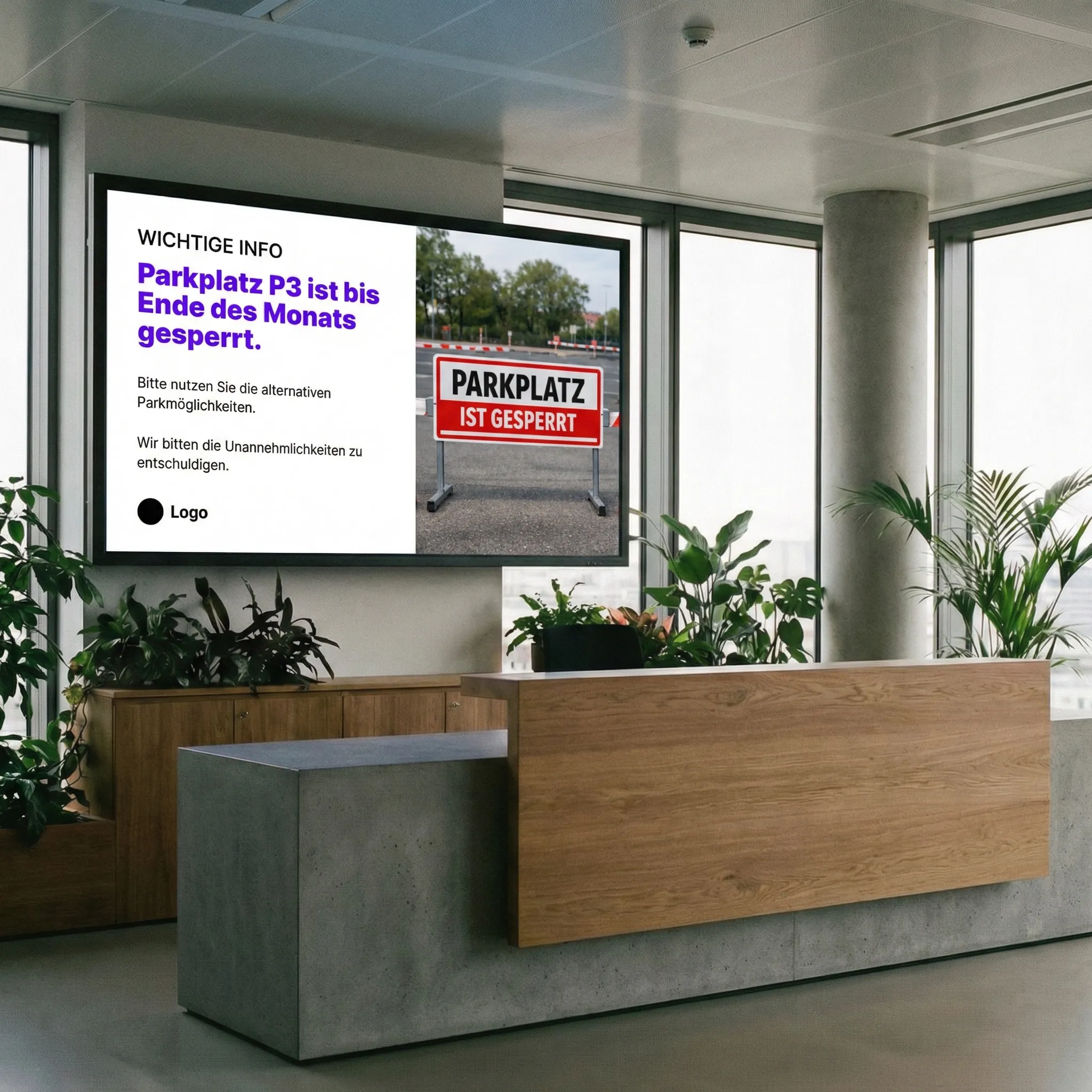
Information screens at central locations (entrances, lounges, production areas) ensure that important information:
- be noticed multiple times
- also reach employees without a PC
- You do not have to actively search
This is a decisive advantage, especially for time-critical or organization-wide messages.
8. Conclusion
A good internal communication consists not only of a clean template, but of a clear structure, a suitable channel and sufficient visibility.
Companies that only send information risk misunderstandings. Companies that make them visible create orientation
Would you like to see how internal messages created centrally and automatically displayed on info screens can be?
Request a 15-minute demo now (free of charge)
Emphasize your product's unique features or benefits to differentiate it from competitors
In nec dictum adipiscing pharetra enim etiam scelerisque dolor purus ipsum egestas cursus vulputate arcu egestas ut eu sed mollis consectetur mattis pharetra curabitur et maecenas in mattis fames consectetur ipsum quis risus mauris aliquam ornare nisl purus at ipsum nulla accumsan consectetur vestibulum suspendisse aliquam condimentum scelerisque lacinia pellentesque vestibulum condimentum turpis ligula pharetra dictum sapien facilisis sapien at sagittis et cursus congue.
- Pharetra curabitur et maecenas in mattis fames consectetur ipsum quis risus.
- Justo urna nisi auctor consequat consectetur dolor lectus blandit.
- Eget egestas volutpat lacinia vestibulum vitae mattis hendrerit.
- Ornare elit odio tellus orci bibendum dictum id sem congue enim amet diam.
Incorporate statistics or specific numbers to highlight the effectiveness or popularity of your offering
Convallis pellentesque ullamcorper sapien sed tristique fermentum proin amet quam tincidunt feugiat vitae neque quisque odio ut pellentesque ac mauris eget lectus. Pretium arcu turpis lacus sapien sit at eu sapien duis magna nunc nibh nam non ut nibh ultrices ultrices elementum egestas enim nisl sed cursus pellentesque sit dignissim enim euismod sit et convallis sed pelis viverra quam at nisl sit pharetra enim nisl nec vestibulum posuere in volutpat sed blandit neque risus.
Use time-sensitive language to encourage immediate action, such as "Limited Time Offer
Feugiat vitae neque quisque odio ut pellentesque ac mauris eget lectus. Pretium arcu turpis lacus sapien sit at eu sapien duis magna nunc nibh nam non ut nibh ultrices ultrices elementum egestas enim nisl sed cursus pellentesque sit dignissim enim euismod sit et convallis sed pelis viverra quam at nisl sit pharetra enim nisl nec vestibulum posuere in volutpat sed blandit neque risus.
- Pharetra curabitur et maecenas in mattis fames consectetur ipsum quis risus.
- Justo urna nisi auctor consequat consectetur dolor lectus blandit.
- Eget egestas volutpat lacinia vestibulum vitae mattis hendrerit.
- Ornare elit odio tellus orci bibendum dictum id sem congue enim amet diam.
Address customer pain points directly by showing how your product solves their problems
Feugiat vitae neque quisque odio ut pellentesque ac mauris eget lectus. Pretium arcu turpis lacus sapien sit at eu sapien duis magna nunc nibh nam non ut nibh ultrices ultrices elementum egestas enim nisl sed cursus pellentesque sit dignissim enim euismod sit et convallis sed pelis viverra quam at nisl sit pharetra enim nisl nec vestibulum posuere in volutpat sed blandit neque risus.
Vel etiam vel amet aenean eget in habitasse nunc duis tellus sem turpis risus aliquam ac volutpat tellus eu faucibus ullamcorper.
Tailor titles to your ideal customer segment using phrases like "Designed for Busy Professionals
Sed pretium id nibh id sit felis vitae volutpat volutpat adipiscing at sodales neque lectus mi phasellus commodo at elit suspendisse ornare faucibus lectus purus viverra in nec aliquet commodo et sed sed nisi tempor mi pellentesque arcu viverra pretium duis enim vulputate dignissim etiam ultrices vitae neque urna proin nibh diam turpis augue lacus.