
Change management communication: What employees really need to understand
Changes rarely fail because of strategy, but because of communication. This article shows what employees really need to understand when it comes to change processes — and how companies create clarity instead of uncertainty.

The basic problem with change
Reorganizations, new tools, new structures or strategic realignments are part of everyday life for modern companies. Nevertheless, change processes often solve employees Uncertainty, resistance, or retreat off.
Not because employees are fundamentally against change — but because they Not understanding enoughWhat actually happens and why.
Why change communication often doesn't work
In many companies, change communication follows the same pattern:
- one-time announcement
- abstract language
- Focus on strategy instead of everyday life
- too much information at once
For employees, this often remains unclear:
- What is changing for myself?
- From when?
- What stays the same?
Without these answers, there is room for speculation.
The decisive question
The central question is not:
“How do we explain change? ”
But:
“What do employees need to understand in order to remain able to act? ”
Change communication is not a presentation — it is orientation.
What employees really need to understand when making changes
1. What is actually changing
Not abstract, but tangible:
- processes
- spools
- processes
- Responsibilities
2. What stays the same
Stability is just as important as change.
3. Why the change is necessary
Not a PowerPoint strategy, but a comprehensible reason.
4. When what happens
Timing reduces uncertainty.
5. Where questions can be asked
Change requires dialogue — or at least clear contacts.
Why repetition is crucial
In change processes, enough Communication is never off. Employees absorb information in phases — depending on role, workload and personal impact.
Therefore, the following applies:
- important messages must Visible multiple times being
- Content must remain consistent
- Communication must not disappear
Repetition is not a sign of poor communication, but of good leadership.
The role of communication channels in change
Change communication requires different channels with a clear function:
- Meetings: Classification & dialogue
- E-mail/ Intranet: Details & documentation
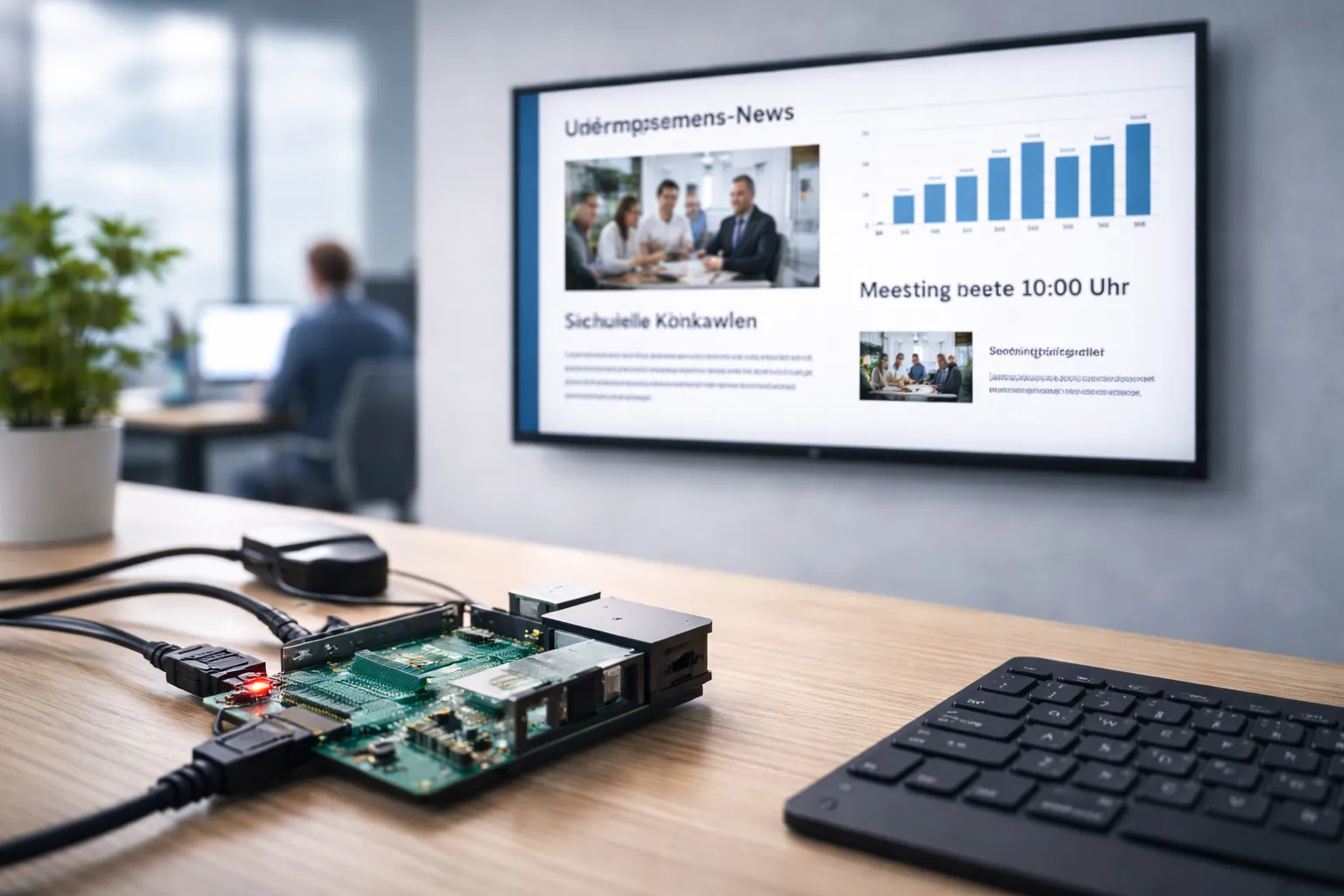
- Visual channels (info screens): Orientation & repetition
Visual channels in particular help, key messages permanently present to hold — regardless of how often meetings take place.
Practical example (simplified)
A company is introducing a new system. The basic message (“Why”, “When”, “What does that mean for whom”) is explained via meetings and made regularly visible on information screens at the same time. In this way, the change remains present without constantly having to be explained anew.
conclusion
Change management communication determines whether changes are accepted or blocked. Employees don't have to understand every strategy — but they need to know What is changing, why and what it means for them. Companies that create clarity reduce resistance and strengthen trust.
Would you like to see how key change messages visible, consistent and across locations Can be communicated? Now free demo request.
Emphasize your product's unique features or benefits to differentiate it from competitors
In nec dictum adipiscing pharetra enim etiam scelerisque dolor purus ipsum egestas cursus vulputate arcu egestas ut eu sed mollis consectetur mattis pharetra curabitur et maecenas in mattis fames consectetur ipsum quis risus mauris aliquam ornare nisl purus at ipsum nulla accumsan consectetur vestibulum suspendisse aliquam condimentum scelerisque lacinia pellentesque vestibulum condimentum turpis ligula pharetra dictum sapien facilisis sapien at sagittis et cursus congue.
- Pharetra curabitur et maecenas in mattis fames consectetur ipsum quis risus.
- Justo urna nisi auctor consequat consectetur dolor lectus blandit.
- Eget egestas volutpat lacinia vestibulum vitae mattis hendrerit.
- Ornare elit odio tellus orci bibendum dictum id sem congue enim amet diam.
Incorporate statistics or specific numbers to highlight the effectiveness or popularity of your offering
Convallis pellentesque ullamcorper sapien sed tristique fermentum proin amet quam tincidunt feugiat vitae neque quisque odio ut pellentesque ac mauris eget lectus. Pretium arcu turpis lacus sapien sit at eu sapien duis magna nunc nibh nam non ut nibh ultrices ultrices elementum egestas enim nisl sed cursus pellentesque sit dignissim enim euismod sit et convallis sed pelis viverra quam at nisl sit pharetra enim nisl nec vestibulum posuere in volutpat sed blandit neque risus.
Use time-sensitive language to encourage immediate action, such as "Limited Time Offer
Feugiat vitae neque quisque odio ut pellentesque ac mauris eget lectus. Pretium arcu turpis lacus sapien sit at eu sapien duis magna nunc nibh nam non ut nibh ultrices ultrices elementum egestas enim nisl sed cursus pellentesque sit dignissim enim euismod sit et convallis sed pelis viverra quam at nisl sit pharetra enim nisl nec vestibulum posuere in volutpat sed blandit neque risus.
- Pharetra curabitur et maecenas in mattis fames consectetur ipsum quis risus.
- Justo urna nisi auctor consequat consectetur dolor lectus blandit.
- Eget egestas volutpat lacinia vestibulum vitae mattis hendrerit.
- Ornare elit odio tellus orci bibendum dictum id sem congue enim amet diam.
Address customer pain points directly by showing how your product solves their problems
Feugiat vitae neque quisque odio ut pellentesque ac mauris eget lectus. Pretium arcu turpis lacus sapien sit at eu sapien duis magna nunc nibh nam non ut nibh ultrices ultrices elementum egestas enim nisl sed cursus pellentesque sit dignissim enim euismod sit et convallis sed pelis viverra quam at nisl sit pharetra enim nisl nec vestibulum posuere in volutpat sed blandit neque risus.
Vel etiam vel amet aenean eget in habitasse nunc duis tellus sem turpis risus aliquam ac volutpat tellus eu faucibus ullamcorper.
Tailor titles to your ideal customer segment using phrases like "Designed for Busy Professionals
Sed pretium id nibh id sit felis vitae volutpat volutpat adipiscing at sodales neque lectus mi phasellus commodo at elit suspendisse ornare faucibus lectus purus viverra in nec aliquet commodo et sed sed nisi tempor mi pellentesque arcu viverra pretium duis enim vulputate dignissim etiam ultrices vitae neque urna proin nibh diam turpis augue lacus.