
Raspberry Pi for internal communication: Useful uses in companies
Raspberry Pi is often seen as a craft project — but in a corporate context, it can be a simple and cost-effective solution for internal communication. This article shows when it makes sense to use it and where the limits lie.
Why Raspberry Pi keeps popping up in companies
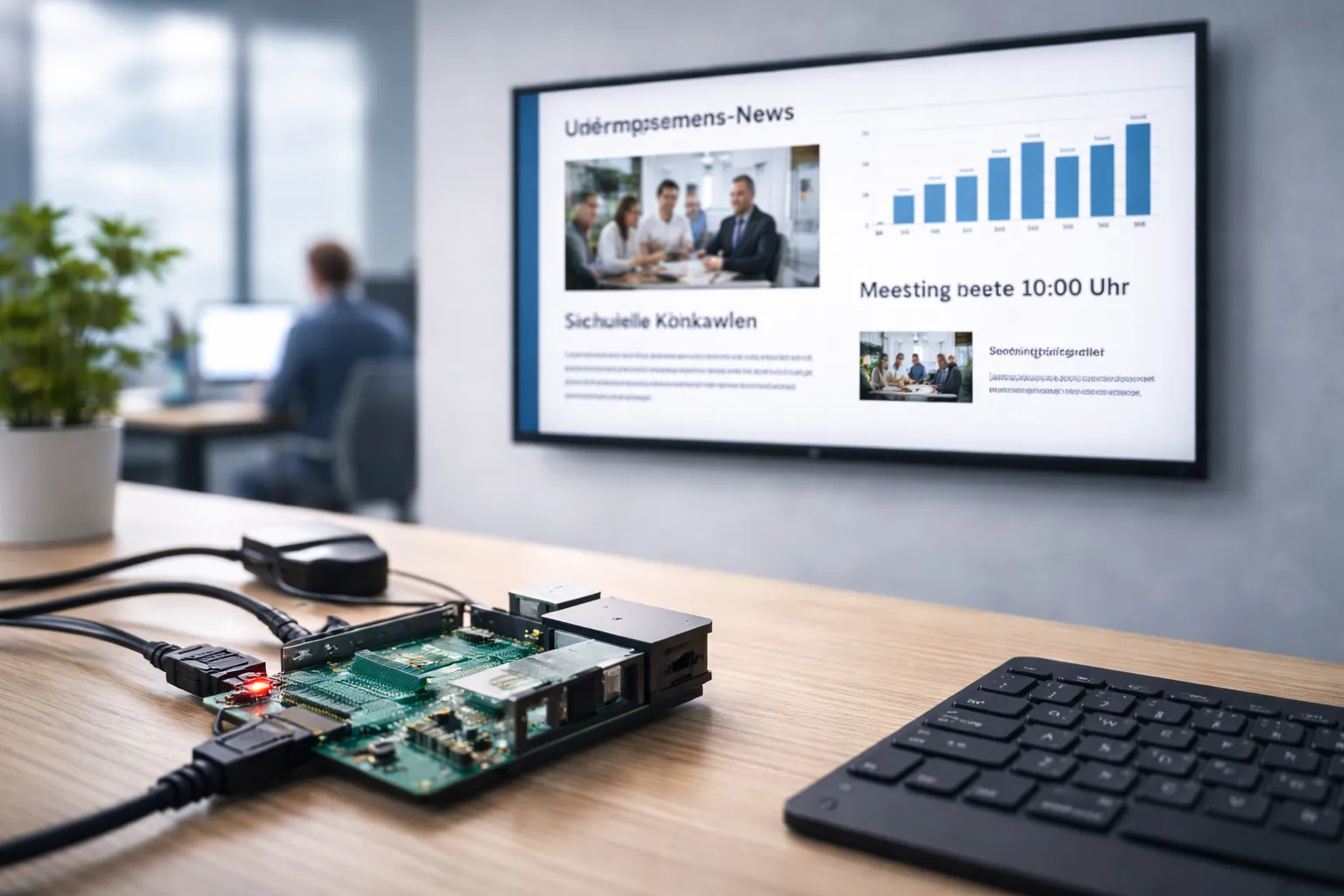
The Raspberry Pi is cheap, flexible and easily available. That is why it appears in many companies sooner or later — usually initiated by IT teams looking for simple solutions for displays, dashboards or info screens search.
Typical questions:
- Can we operate info screens ourselves?
- Is a Raspberry Pi enough for this?
- Is that stable enough for continuous operation?
The short answer: Yes — subject to certain conditions.
Typical use cases for Raspberry Pi
In practice, Raspberry Pi is often used in companies for:
- simple info screens (news, dates, key figures)
- Dashboards in production or logistics
- Advertisements in break rooms or entrance areas
- temporary solutions or pilot projects
Getting started is easy, especially for initial tests or small setups.
The decisive question
The central question is not:
“Does Raspberry Pi work? ”
But:
“How much operation and maintenance do we want to take over in the long term? ”
Because hardware is only part of the solution — Operation, updates and content are crucial.
Benefits of Raspberry Pi for internal communication
✔ Low costs
Very low purchase costs per device.
✔ Can be used flexibly
Supports various operating systems and players.
✔ IT friendly
Ideal for teams that like to configure themselves.
✔ Good picture quality
Absolutely sufficient for simple presentation of information.
Where Raspberry Pi is reaching its limits
❌ Maintenance costs
Updates, outages and configuration must be managed internally.
❌ Scaling
What works with 1-2 screens quickly becomes complex with 20+.
❌ Content maintenance
Without central software, content must be prepared manually or technically.
❌ Dependence on IT
HR or communications are often unable to maintain content themselves.
❌ Low performance in 24/7 operation.
Raspberry Pi vs. classic digital signage players
The Raspberry Pi is not a substitute for a communication strategy, but a Baustein.
Typical division of tasks:
- Raspberry Pi: Hardware/Player
- Software: central control, content, rights, schedules
It is only the combination that makes the use worthwhile in the long term.
Practical example (simplified)
A company uses Raspberry Pis as a cost-effective player at several locations. Content is maintained centrally and automatically played to the devices. HR and internal communication can update content themselves; IT only manages the hardware.
This keeps the technical effort manageable — and communication flexible.
conclusion
Raspberry Pi can be a good solution for internal communication — When used correctly. As a hardware basis, it is inexpensive and flexible. However, the decisive factor is how content is created, managed and played out. Companies that cleanly separate technology and communication benefit the most. If you're looking for a professional, scalable and secure solution, reserve one now free consultation with our experts.
Emphasize your product's unique features or benefits to differentiate it from competitors
In nec dictum adipiscing pharetra enim etiam scelerisque dolor purus ipsum egestas cursus vulputate arcu egestas ut eu sed mollis consectetur mattis pharetra curabitur et maecenas in mattis fames consectetur ipsum quis risus mauris aliquam ornare nisl purus at ipsum nulla accumsan consectetur vestibulum suspendisse aliquam condimentum scelerisque lacinia pellentesque vestibulum condimentum turpis ligula pharetra dictum sapien facilisis sapien at sagittis et cursus congue.
- Pharetra curabitur et maecenas in mattis fames consectetur ipsum quis risus.
- Justo urna nisi auctor consequat consectetur dolor lectus blandit.
- Eget egestas volutpat lacinia vestibulum vitae mattis hendrerit.
- Ornare elit odio tellus orci bibendum dictum id sem congue enim amet diam.
Incorporate statistics or specific numbers to highlight the effectiveness or popularity of your offering
Convallis pellentesque ullamcorper sapien sed tristique fermentum proin amet quam tincidunt feugiat vitae neque quisque odio ut pellentesque ac mauris eget lectus. Pretium arcu turpis lacus sapien sit at eu sapien duis magna nunc nibh nam non ut nibh ultrices ultrices elementum egestas enim nisl sed cursus pellentesque sit dignissim enim euismod sit et convallis sed pelis viverra quam at nisl sit pharetra enim nisl nec vestibulum posuere in volutpat sed blandit neque risus.
Use time-sensitive language to encourage immediate action, such as "Limited Time Offer
Feugiat vitae neque quisque odio ut pellentesque ac mauris eget lectus. Pretium arcu turpis lacus sapien sit at eu sapien duis magna nunc nibh nam non ut nibh ultrices ultrices elementum egestas enim nisl sed cursus pellentesque sit dignissim enim euismod sit et convallis sed pelis viverra quam at nisl sit pharetra enim nisl nec vestibulum posuere in volutpat sed blandit neque risus.
- Pharetra curabitur et maecenas in mattis fames consectetur ipsum quis risus.
- Justo urna nisi auctor consequat consectetur dolor lectus blandit.
- Eget egestas volutpat lacinia vestibulum vitae mattis hendrerit.
- Ornare elit odio tellus orci bibendum dictum id sem congue enim amet diam.
Address customer pain points directly by showing how your product solves their problems
Feugiat vitae neque quisque odio ut pellentesque ac mauris eget lectus. Pretium arcu turpis lacus sapien sit at eu sapien duis magna nunc nibh nam non ut nibh ultrices ultrices elementum egestas enim nisl sed cursus pellentesque sit dignissim enim euismod sit et convallis sed pelis viverra quam at nisl sit pharetra enim nisl nec vestibulum posuere in volutpat sed blandit neque risus.
Vel etiam vel amet aenean eget in habitasse nunc duis tellus sem turpis risus aliquam ac volutpat tellus eu faucibus ullamcorper.
Tailor titles to your ideal customer segment using phrases like "Designed for Busy Professionals
Sed pretium id nibh id sit felis vitae volutpat volutpat adipiscing at sodales neque lectus mi phasellus commodo at elit suspendisse ornare faucibus lectus purus viverra in nec aliquet commodo et sed sed nisi tempor mi pellentesque arcu viverra pretium duis enim vulputate dignissim etiam ultrices vitae neque urna proin nibh diam turpis augue lacus.